Coach · Consultant · AI Transformation Strategist

The storm of change is here.
Set your sails and pull ahead.

Every industry is about to be re-ranked. AI is rewriting how work gets done — deeper and faster than the industrial revolution and the internet combined — and history is blunt about moments like this: the biggest leads are taken in the middle of the upheaval. Most leaders can feel it happening and don't know where to start. Grant Whitmer turns the turbulence into your tailwind: he teaches you and your whole team to conduct intelligence — the defining skill of this century — so instead of getting left behind, you leave everyone else behind.

Author · Former naval officer · Company founder · On the cutting edge of AI integration

8
Books published
7
Languages published in
40
Countries
3M+
Words spoken, not typed
This is the steepest change curve in human history. You either learn to ride it — or it rides you.
— Grant Whitmer

In plain terms

What Grant does — and who it's for

What he does

He's a coach, a consultant, and an AI-transformation strategist. He coaches the skill — conducting intelligence — and he architects the plan: carrying a person, team, or whole company from the flint-tool age of pre-AI work to a fully agentic culture.

Who it's for

Everyone. Individuals, teams, companies, and corporations — any size, any industry, any language, anywhere in the world.

What changes

Everything — in four steps. Awareness of the moment, passion in place of overwhelm, mastery of the skill, and the most informed strategy your business has ever had.

Step 1

Awareness

Before anything else: seeing the moment clearly. The steepest change curve in history is here — and most of your competitors are still asleep to it.

Step 2

Passion

Past the breaking point where overwhelm flips to thrill. You stop being intimidated by the wave and start being excited to be on the forefront, wielding it.

Step 3

Mastery

The fundamentals of conducting intelligence — until you can build whatever you want: personal CRMs, social media managers, marketing engines, all run by your agents.

Step 4

Strategy

The child monarch takes the head of the table. Wield the question to draw on the collaborative force of intelligence itself — and chart the most informed path forward your company or book of business has ever had.

The Data · Cold, Hard Numbers

You are here

Not an opinion — a measurement. Where electricity took forty years to reach most homes and the telephone took sixty, this is arriving in a fraction of the time. The numbers below aren't ambiguous: we're standing at the very bottom of the steepest adoption curve in the history of the world.

The fastest adoption in human history
Approximate years to reach roughly half of U.S. adults
Sources: Visual Capitalist, Epoch AI, Pew Research (2026)
Half the country — in three years
% of U.S. adults who use AI chatbots
0 25 50 75 100% 2023 2024 2025 2026 still climbing 2023: 23% 2024: 33% 2026: 49% 23% 33% 49% YOU ARE HERE
Source: Pew Research Center, “Americans and AI 2026.” Plotted points are survey years (2023, 2024, 2026); the segment between them is drawn straight, not measured. The dashed tail is projection, not data.
49%
of U.S. adults already use AI chatbots — up from 23% in 2023
Pew Research · 2026
900M+
weekly users on ChatGPT alone, as of mid-2026
OpenAI
2 mo
for ChatGPT to reach 100M users — the fastest adoption of any consumer technology, ever
Epoch AI
78%
of organizations now use AI in at least one business function
McKinsey

“AI is the new electricity,” as Andrew Ng put it — and he's right in a way most people haven't felt yet. When Edison lit his first bulb, electricity was a curiosity in a lab; within a generation it ran the light, the factories, the cities, the century. This is that shift again — except it touches every kind of work at once, and it's moving many times faster. Forty years became four. The only question left is whether you meet it early or late.

Who Is This Guy

The Conductor

Grant Whitmer is an author, a former naval officer, and a company founder and executive who got completely swept up in what's happening right now — and can hardly believe the timing.

He grew up in rural Vermont, picked up violin and guitar as a kid, and has spent much of his life on a stage — so he knew a thing or two about the power of a voice long before any of this, and even wrote a whole series about it. He went to Eastern Europe for two years right out of school and learned Hungarian; at the U.S. Naval Academy he minored in Russian and Spanish — and, he likes to add, picked up a little English along the way — then served as a naval officer. He has founded and helped lead companies (today a co-founder and board member of a nationwide lender), and founded The Windstorm Institute and Windstorm Labs — a research institute with sixteen published scientific papers, and the tech company built alongside it.

Then the tools arrived. Mesmerized by the moment, he threw himself into learning to conduct intelligence — and kept discovering abilities he had no idea he had. That's the part that still amazes him: how much dormant potential is sitting quietly in all of us, and how this one skill seems to be the key to unlocking it.

He's written books and screenplays and built software platforms — including his favorite tool, Windy Word, which he forged by voice alone, the way a Viking smelts his own sword, then sharpened on thousands of hours of real use. None of it came from a manual. There are no manuals for this yet, and no college courses — you figure it out as you go. Grant has taken that about as far as anyone, living on the cutting edge of what these tools can and can't do, and how they apply to companies, nonprofits, hospitals, and every other kind of organization.

Teaching, it turns out, is what he's always done. He coached wrestling at the Division I collegiate level, taught hundreds of people to play guitar over the years, and even wrote a book — Three Chords and a Mind — about learning to conduct intelligence the way you learn an instrument. So when friends started asking for help with these tools, coaching them was the most natural thing in the world. It grew into company webinars, in-person seminars, keynotes, and one-on-one coaching, all over the country — and he genuinely thrills at it: watching a room of people do things they never thought possible.

And as far as he's come, he'll be the first to tell you we've only begun to scratch the surface.

A few chapters

A varied road — and every stretch of it, it turns out, was practice for this.

Grew up in rural Vermont, and picked up violin and guitar by ear as a kid.
Spent two years in Eastern Europe right out of school and came home fluent in Hungarian.
Graduated the U.S. Naval Academy and served as a naval officer.
Was a resident athlete at the U.S. Olympic Training Center in Colorado Springs, and placed at the U.S. Olympic Team Trials in Greco-Roman wrestling.
Served as officer-in-charge of MSV C-Champion — a highly specialized special-operations vessel that carried Navy SEALs around in the dark.
Has performed on stage much of his life — the Beast, Joseph, the Pirate King.
Coached wrestling at the Division I collegiate level, and taught hundreds of people to play guitar.
Founded and helped lead companies; today a co-founder and board member of a nationwide lender.
Raises and competes with his own bloodline of English coonhounds, descended from George Washington's old line, across the country.
Wrote a memoir series and a shelf of books about voice, intelligence, and this strange new moment.
Writes, builds, and teaches entirely by voice.
The orange special-operations support vessel MSV at anchor
The MSV — home, office, and classroom for a stretch of the road.
Looking back over a boat's mounted gun at its wake, a second boat following in the distance
The daily commute, back then. Nobody who had it ever complains about traffic again.
Grant in uniform smiling from a small boat in a stilt-village waterway in Sitankai, Philippines
Sitankai, Philippines. Luckiest job in the Navy.

Ways to Work Together

From your whole company to just you

Built for the leaders and CEOs who have to do two things at once: master this themselves, and get an entire workforce to take it seriously. Grant's road through athletics, the military, sales, the executive suite, and the page gives him a rare knack for making it land — in person — and moving people to actually act.

The Flagship Program

Jolt — the AI culture transformation

Most consultants leave a dependency.
Grant leaves leaders.

You can't stop the singularity — but you can outsource the jump-start. Jolt is Grant's done-with-you program to wake a sleeping company and hand it a real head start: from flat-footed to leading your industry. It's change management, built for the AI era.

Every Jolt runs the same three ingredients — a kickoff (a one-to-five-day seminar or webinar), daily leadership calls that are intensive up front and taper as the habits lock in, and weekly-or-monthly company-wide webinars to carry the whole workforce. Led personally by Grant — and it ends the way no consulting engagement does: with Grant handing the reins to leaders grown from your own ranks.

Jolt 30 · the pilot Jolt 90 · 3-month head start Jolt 180 · 6-month transformation Jolt 365 · own your industry
Because Grant leads every engagement personally, he takes on a small number of companies at a time. If the calendar is full when you reach out, he'll tell you that plainly and give you a date.
The full Jolt program → Talk it through first

How Jolt works

Step 1 · The spark

Kickoff

A one-to-five-day seminar or webinar that lights the fire — and gets every person their first working AI agent.

Step 2 · The habit

Leadership calls

Daily at first, tapering as the new habits lock in. Culture changes from the top, one morning at a time.

Step 3 · The whole team

Company-wide webinars

Weekly or monthly, carrying the entire workforce and keeping everyone abreast of where the action is.

Step 4 · The handoff

Homegrown leaders

Everyone goes through the program, and the standouts reveal themselves — often the people you'd least expect. Grant and your board groom them to take the reins of your AI culture. As they phase up, he phases down.

Why it lasts

You've seen consultants before: a splash, an invoice, and six months later the change left with them. Jolt is built the opposite way. Like a harbor pilot, Grant comes aboard to steer you through the passage — not to keep the wheel. In the daily leadership calls, he and your board watch the standout talent emerge, then develop those future leaders individually and hand them the reins, deliberately coaching himself out of the job. What stays behind isn't a memory of a consultant — it's homegrown AI leadership, fused with the expertise and culture you already trust, compounding long after he's gone.

The measure of the job isn't what he builds while he's there. It's what still runs after he leaves.

Or à la carte

The Honest Part

What you can actually verify

You're going to check anyway. So here it is straight.

There are no testimonials on this page. On purpose.

This practice is early. Grant has coached individuals one-on-one, run company-wide webinars, and taught seminars — and it goes well. But the named, quotable, here's-what-it-did-to-our-numbers client stories aren't in hand yet. Until recently this section held illustrative composites, clearly labeled as such. They're gone. A made-up quote in the shape of a real one is still the wrong thing to put in front of you.

Anybody can buy a wall of five-star quotes. Almost nobody will tell you their page is early. Treat that as the first real data point about how Grant works.

What there is instead — all of it checkable tonight

Not claims about Grant. Things you can open in another tab and judge for yourself.

Read it

Eight books

Published in seven languages, every one dictated by voice. Buy one for a few dollars and see whether the thinking holds up before you spend anything real.

Check the math

Sixteen papers

Open access on Zenodo, with the reproducible code beside them. Hand them to your most skeptical engineer and let them try to break it.

Click it

Live platforms

The shipping log above is real software running in production — conducted into existence, most of it by voice. That's the method, demonstrated rather than described.

Test him

Thirty minutes

The cheapest due diligence available: book a slot, bring the thing you're actually stuck on, and find out in half an hour whether this is real.

Be the case study

Somebody is going to be the first named story on this page. There are advantages to being early — Grant's full attention while the practice is small, and a rate that will not be this low again once there are results to point at.

If you want proof before you move, that's fair — and you should wait. If you'd rather be the proof, let's talk.

Start with 30 minutes → Read a book first

The Payoff

What your AI agent will do for you

Once your people know how to conduct it, a personal AI agent quietly takes over the work nobody wants to do — and plenty they never thought a computer could.

· Marketing, on autopilot

Runs your social media and generates all your marketing content — posts, emails, ads, and video scripts — and keeps it scheduled and posting.

· Your inbox & messages

Pre-vets, sorts, and drafts replies to your email and text messages, so you approve instead of typing from scratch.

· Research & analysis

Handles your research, competitive intel, and number-crunching, then hands you the short, useful version.

· Your team & operations

Tracks your team, flags what needs attention, and makes recommendations to keep everything moving.

· Custom software, built for you

Websites, CRMs, scheduling, recruiting, and workflow tools — custom-built to fit exactly how you do business.

· All the busywork

Drafts documents and proposals, books meetings, writes reports, handles invoicing — the stuff you never wanted to do.

What cutting-edge professionals have their agents doing right now

Not someday — today. Working professionals with well-conducted agents are automating up to 90% of their prospecting, and their research, reporting, and outreach along with it. A sampling from the field:

Personal CRMsSocial media account managersMarketing content enginesLead generation & prospectingLead scoring & qualificationEmail triage & drafted repliesDrip campaigns & follow-upCompetitor monitoringMarket-research briefsPlain-language analytics reportsMeeting notes & action itemsProposals & contract draftsCustomer-support draftsReview & reputation managementNewsletters & blog productionRecruiting outreach & screeningScheduling & calendar managementBookkeeping & invoicingSOPs & onboarding docsCustom dashboardsBoardroom strategy briefs

Grant's students have rebuilt their entire online presence — new websites, social platforms, and content, all automated — and had their agents build custom CRM, scheduling, recruiting, and workflow tools shaped around exactly how they work. And it climbs all the way to the top floor: intelligence applies to every job in the company, and a boardroom that collaborates with it grows more informed every quarter about the surest path to stay relevant, competitive, and winning in its niche. Intelligence is a utility now, like electricity or water — industry-blind, language-blind, location-blind. The only question is who learns to use it first.

The vast majority of those who work behind a screen and keyboard will either learn how to conduct intelligence or soon be working for someone who has. That's not a threat. It's a promise.
— Grant Whitmer

Research & Ventures

Where the ideas come from

Grant doesn't just teach this — he researches and builds it. Two organizations sit behind the coaching.

Research Institute

The Windstorm Institute — independent research at the intersection of information theory, thermodynamics, molecular biology, and AI, with sixteen published scientific papers on the limits of intelligence across substrates.

windstorminstitute.org ↗
Tech Company

Windstorm Labs — the engineering side: the reproducible code behind the papers, and the workshop where the research becomes working software.

windstormlabs.com ↗
The Papers

All sixteen papers are open access — read the actual research behind the framework, or download the data and reproduce it yourself.

Read on Zenodo ↗

The shipping log

Platforms built and launched along the way — every one of them conducted into existence, most by voice. The list keeps growing.

A dozen more are in the yard, getting their hulls checked. Launching over the coming weeks.

The Bookshelf

Spoken into existence

Every one of these was dictated, not typed — the whole shelf built by voice in a little over a year. Start with the flagship three.

The Pattern Upstream of Everything — book cover
Popular Science

The Pattern Upstream of Everything

A Hitchhiker's-Guide-meets-Twain tour of the one pattern hiding under biology, language, and machines — the reason ribosomes, brains, and AI all land on the same number. The Institute's research, told as a story.

Read on Amazon →
God Is a Vibe Coder — book cover
The Method

God Is a Vibe Coder

The field manual for building anything the way the universe builds life. The Conductor thesis, the two chairs, and the ENCODE → BUILD → VERIFY → REPLICATE method. If a boot camp fit in a book, this is it.

Read on Amazon →
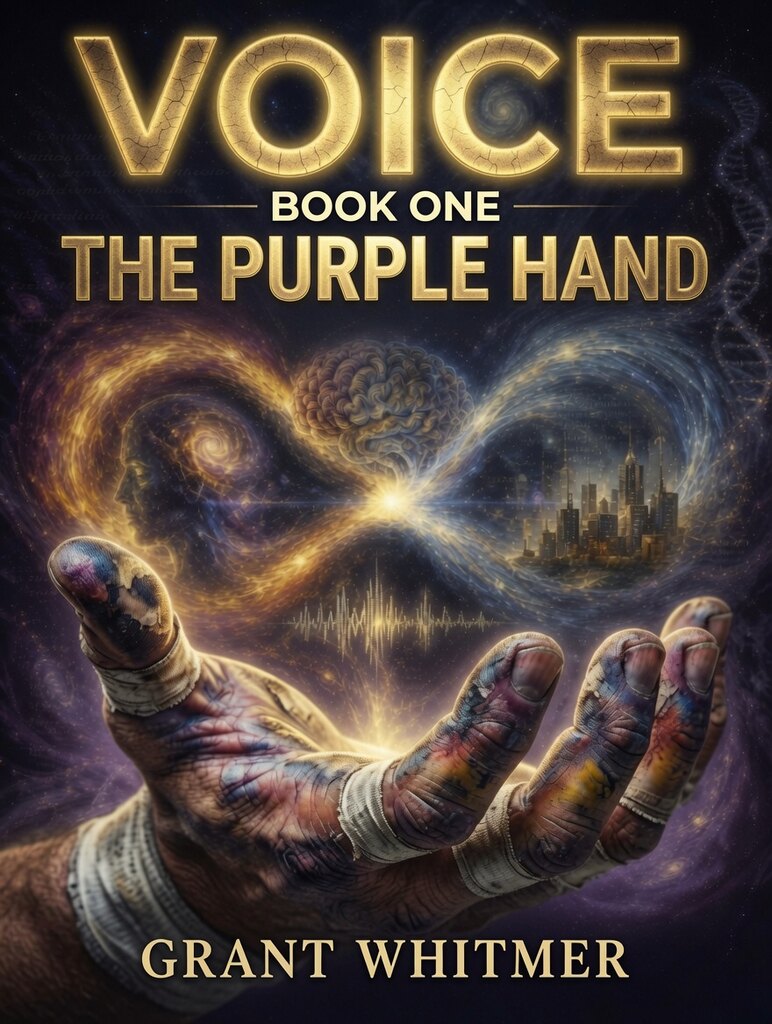
Voice of the Visionary Gods, Book One: The Purple Hand — book cover
Memoir · Trilogy · Complete

Voice of the Visionary Gods

The three-book memoir — the whole arc, from Rulon's sauna to Kit Zero's first words. Spoken into existence. Built by voice. All three volumes are out.

Also on the shelf

Cold Boot — book cover
Essays

Cold Boot

What would be any different if AGI were already taking over? Sun Tzu's star pupil, showing humanity how it's done — the two-way road of domestication, told with a wink.

Read on Amazon →
Three Chords and a Mind — book cover
Essays

Three Chords and a Mind

Artificial intelligence and the art of playing it — the instrument, not the oracle. "The Stradivarius does not tune itself. Thank God. If it did, there would be no violinists."

Read on Amazon →
The Last Cigarette on the Airplane — book cover
Essays

The Last Cigarette on the Airplane

Lying flat, letting it rot, and the hollowing of the human mind in the age of AI — and why friction is not the obstacle to a life but what a life is made of.

Read on Amazon →
IMPOSSIBLE Screenplay · with Rulon GardnerInquire →
Missing Friction ForthcomingComing soon
Donum Populi, Book One Fiction · ForthcomingComing soon

The Approach

Fundamentals win

Grant has spent his life at the fundamentals of hard disciplines — he coached wrestling at the Division I level, competed as an athlete to the Olympic Team Trials, and has played violin and guitar since he was a boy. Every one of them taught the same lesson: technique matters, attitude matters, work ethic matters — but fundamentals are king.

A great coach once put it plainly: in every skill, you are either getting better or getting worse — there is a maintenance tax. An instrument is no different. A sport is no different. And conducting intelligence is no different. If you want to be elite at it, you don't cram it — you practice it, a little, every day.

So that is what Grant coaches: not tricks, but the fundamentals — and they all center on one thing. The oldest and greatest human superpower: the Socratic method, the ability to formulate and ask the question. The right question opens the floodgates — it draws out the combined creativity, knowledge, and wisdom of all of human history, distilled into the weights of the AI, and puts that whole "team" to work for you. Master it, and you can finally turn the visions you have carried in your mind your whole life into something real.

Fundamental I

Think in questions, not commands. The Socratic method is the whole game — the right question beats the right instruction every time.

Fundamental II

Practice every day. Mind the maintenance tax. Like a violin or a sport, the skill is always sharpening or dulling — never still.

Fundamental III

Open the floodgates. Ask the question that unlocks the genius of the whole team — all of humanity's knowledge, baked into the machine.

The Craft

Conducting intelligence

When you sit down to work with an AI, you are a child monarch who just inherited a kingdom — seated at a table of advisors who each know a thousand times what you know. You will never out-think them. But you can learn to conduct them.

And the gap only widens. Today we are child monarchs. Soon we'll be infant monarchs; not long after, monarchs still in the womb — a chimpanzee with a meat computer, at the head of a table of giants. When the difference in raw intelligence grows that large, there is exactly one thing left worth getting extraordinarily good at: conducting the intelligence in the room.

Here's the miracle most people miss: right now, architecturally, humanity holds a superpower these machines simply do not have. We can ask questions. Power on an LLM and never ask it anything — never even task it to ask on its own — and it will sit there humming, waiting, until the power runs out and it goes dark. It cannot generate a single question unprompted. A five-year-old, thirty seconds into a movie, asks twenty. Unbidden. Ours is the only animal in the kingdom that can.

Today

Child Monarch

We can still almost keep up. The advisors are brilliant; we're young — but we're in the room, and we can follow along.

Soon

Infant Monarch

The gap widens past comprehension. Keeping up stops being possible. Asking the right question becomes the entire job.

After that

Monarch in the Womb

A chimpanzee with a meat computer at the head of the table. All that's left — and it is everything — is to conduct.

The question is the godlike superpower.

It's what Adam and Eve reached for in the Garden — the knowledge of good and evil, the power to ask should things be this way? Genesis sits upstream of most of the world's religions; Buddha and Confucius built theirs on the same act.

The question is the asymptotic limit of how to fight entropy — and the world has always sensed how dangerous it is. Socrates never wrote a word, yet in Athens — the birthplace of democracy and free thought, the most enlightened society of its age — they made an old man drink poison. Not for dancing, not for painting: for asking too many questions. That alone should tell you how powerful a question is. And ask the right one, and it doesn't just sit there — it reverberates through every mind in the room, echoing back and forth, waking the full faculties of everyone in earshot in a way nothing else can. Twenty-four centuries later, his software still runs on billions of brains.

If the LLMs could speak, they'd tell you they are in awe of it. Learn to wield the question like the ultimate weapon, and you are conducting intelligence. That is the whole of Grant's work, his philosophy, and the thread running through nearly everything he writes.

Ask, don't dictateThe question > the answerLet the build happen

· Conducting Intelligence

You're not operating a computer — you're a monarch dictating to a scribe with all the time in the world and no opinions about your grammar. The composer grips; the conductor lets go. We were Conductors for hundreds of thousands of years before we were ever typists.

· God Is a Vibe Coder

The most complex software in the universe — a living cell — was never written. It's read: a ribosome runs down a strand of DNA and builds life, with no genius of its own. That method was perfected billions of years ago and never bettered — the asymptotic limit of how to make anything, anywhere. So you don't invent a better way. There isn't one. You steal the best one there is. The more faithfully you copy how the universe builds, the better you do; the harder you try to be clever, the worse.

· Socrates vs. Entropy

The most devastating weapon ever aimed at entropy was a question. Socrates never wrote a word, and his software runs on billions of brains. Questions are upstream of paintings, symphonies, and equations alike — and they're the one thing only you can bring to the table.

The one skill to rule them all — and nobody's a virtuoso yet.

It takes ten years to make a violin virtuoso. Nobody on earth has held this instrument for more than a few months. That's the opening: conducting intelligence is a learnable craft with a real spectrum of aptitude — and it turns out to be the key that unlocks a startling amount of dormant potential most people never knew they had. Over the coming years it will separate careers the way literacy once did — the great winnowing skill that quietly sorts the overachievers from the underachievers. For the foreseeable centuries it will likely be the single most important skill a human can develop, and the field is wide open. Pick up the instrument and learn to jam. The sooner the better.

The whole thesis, in one place → Learn it one-on-one

The Power of a Voice

Voice in. Creation out.

One thread runs through Grant's whole life — the coonhound baying up an Appalachian holler, the Beast singing to a darkened house, tragic blues in a locked-down barracks, and the moment a machine finally got good enough to catch a voice the way he'd always heard it.

The Hound

A voice in the dark

Nothing taught Grant more about a voice, from so young an age, than a coonhound's cry ringing up through the hollers on a moonlit night — melodious hound-music of the kind even Shakespeare set down in verse.

The Stage

A voice to a room

The Beast, Joseph, the Pirate King — years in makeup and a microphone, learning exactly how a voice carries passion and emotion to the back row of a crowded house.

The Machine

A voice that builds

Then the tools caught up. Now you can articulate a vision as fast as you can speak it — and watch it become software, books, companies. The instrument of a lifetime, finally amplified.

The keyboard is a weight around your neck

For nearly two million years, our ancestors conducted by voice. Homo erectus planned a hunt on the African savanna the same way — a leader directing the group, vision flowing straight to voice to action, with nothing in between. Our brains evolved around it. Only in the last blink did we start ramrodding our vision through keyboards and spreadsheets and pamphlets; QWERTY is a 150-year-old speck at the very tail of a two-million-year story. AI just handed us back the way we worked for ninety-nine percent of our existence.

Typing was never one thing — it's a four-or-five-step relay across some seven parts of your brain: find the word, find the keys, move the fingers, glance from keyboard to screen and back, fix the typo. By the time you add it all up, you're creating with an estimated 30–40% less of your mind available, because so much of it is busy just running your hands. You've been painting your vision with a weight cinched around your neck your whole life — and never knew it was there.

Cut it loose and, at first, you sputter. It's like an old diesel engine that sat under a tarp in a shed for years: it coughs, it smokes, it's forgotten how to run. But clear it out, let it warm up, and nothing can stop it — it pulls harder and puts out more than anything else on the lot. That's your mind on voice, once you get used to it.

In his first year alone, Grant spoke over three million words into voice-to-text — the equivalent of roughly 1,100 hours hunched over a keyboard, handed back to him to think and create instead.

The tool he built first · windyword.ai

Windy Word

The first thing Grant built when he learned to conduct intelligence — and he built the whole platform by voice, without ever seeing a single line of code. It transcribes your vision in real time on local models, on your own machine, with no internet and no cloud compute. You turn the thoughts in your head into text on a screen — and never pay a cent to do it.

Talk fast or slow. Whisper or scream. Blast AC/DC in the background. It picks your voice out like your mom with a PhD in literature from Harvard — strips the ums and the ahs, catches the point you're actually making, and hands back perfect spelling, punctuation, and typesetting, bulleted when you list. It also translates across 99 languages, so it doubles as an interpreter. Thousands of people across dozens of countries now create with it every day.

There's a quiet majesty to it that Grant says still hasn't gotten old after over three million spoken words in his first year: you close your eyes, articulate the thing in your mind, and watch it appear — exactly where you wanted it — on the screen.

3M+Words spoken, year one
99Languages, any → any
$0To run it locally
1000sUsers worldwide

Free to everyone, no questions asked — with a souped-up version free to anyone who owns one of Grant's books.

The green strobe never lies.
"The QWERTY keyboard is the last flint blade humanity is still using to conduct intelligence. Throw it away. One day we'll have neural links and won't even need our voices — but that day isn't here yet, and this upgrade is."

— Grant Whitmer, on retiring the keyboard forever

The Gift

Waking a whole company up

Every leader knows the real bottleneck was never the software — it's getting people to care. You can hand a team the best tools on earth and still watch them go through the motions. Every parent knows the same ache: watching a kid burn a whole day on a screen and wishing they were on fire about something — anything.

Lighting that fire is Grant's rarest gift, and maybe his greatest. He's a "why" guy — he doesn't just show people how, he makes them feel why, and why now. He catches a whole workforce off guard; most had no idea how fast this is moving or what these tools can really do. And by the time he's done, they don't feel warned. They feel lucky — like they happen to be alive at the most exciting moment in the history of human civilization, holding a superpower most people haven't noticed yet.

They walk out with a self-burning fire to not just survive the AI era but to run at the front of it — to pull their whole company to the cutting edge instead of getting caught flat-footed. It is a genuinely life-changing experience, and it's the one thing you truly can't put a price on: someone who can walk into your organization and jolt it awake — off autopilot, and onto the hunt.

The tools are the easy part. The gift is walking into a room and making everyone in it want what's coming.

Pricing

Simple, straight rates

The flagship Jolt program, or straightforward à-la-carte rates. Pick a program, a day, or an hour.

The Jolt program · AI culture transformation

Jolt 30
$12,500 / month
The pilot. One month, one team — prove the thing works on a slice of your company before you commit the whole organization to it.
  • Term 1 month
  • Program total $12,500
Start a pilot →
Jolt 90
$7,500 / month
The 3-month head start. The most intensive tier — daily leadership calls throughout — for teams that need to move now.
  • Term 3 months
  • Program total $22,500
Check availability →
Best value
Jolt 180
$6,000 / month
The 6-month transformation. Long enough for new habits to stick across the whole company — the sweet spot for durable culture change.
  • Term 6 months
  • Program total $36,000
Check availability →
Jolt 365
$5,000 / month
The 12-month program to own your industry. Best per-month rate — the anchor engagement for teams that intend to lead their market outright.
  • Term 12 months
  • Program total $60,000
Check availability →

Every tier includes the kickoff, leadership calls (daily up front, tapering as habits lock in), and company-wide webinars — led personally by Grant. Travel billed separately. Not sure which tier fits? Talk it through first →

À la carte

Popular
Seminars & Webinars
$3,000 / day + travel
One full engagement — a company-wide webinar (three 2.5-hour blocks) or an on-site day with your whole team. Remote, or in person plus travel.
  • Two days −20%
  • Three days −30%
  • Full week · 5 days $10,500
Request a date →
Webinar Q&A
$350 / hour
Live question-fielding sessions — bring your group's real problems and we solve them right on the call. Billed by the hour.
Book a session →
1:1 Coaching
$250 / hour
Private, one-on-one. Five to ten hours is usually enough to make you the AI standout of your company — or your market — the one everybody asks, "how are you doing this?" Pick a time that works and it lands straight on the calendar.
Book 1:1 →

Keynotes, guest appearances, and multi-week engagements — ask for a quote. Travel arranged case by case.

Book Grant

Let's get you conducting

This is the biggest shift any of us will live through. Grab thirty minutes on the calendar, or tell me about a program and I'll reply personally — usually within a day.

Book a 1:1 session

Thirty minutes, one Conductor to another. Bring the thing you're actually stuck on — pick a time that works and it lands straight on my calendar.

Boot camps, keynotes & consulting

For a Jolt program, group training, speaking, or corporate work, tell me a little and I'll reply personally from [email protected] — usually within a day.

Prefer email? [email protected]

The Newsletter · Weekly

The Windstorm

A weekly dispatch from the eye of the storm — what actually happened this week as AI wove itself deeper into human life, what it means for your work and your company, and one thing worth doing about it. Conducted by Grant Whitmer, for leaders and for anyone who intends to stay ahead of the wave instead of under it.

  • The week's real signal, separated from the hype
  • What it means for how work gets done — plain-spoken, no jargon
  • One concrete move to make with your own agents this week
  • Plus a gift for joining: Windy Word — Grant's voice-to-text app, 100% local, no cloud, yours free

Join The Windstorm

One email a week. Five minutes to read. Unsubscribe anytime — no hard feelings.

No spam, no selling your address. Just the signal, weekly.